
How to verify an electrician's license in Florida before you hire
By Thomas Quinn · Updated 2026-06-28
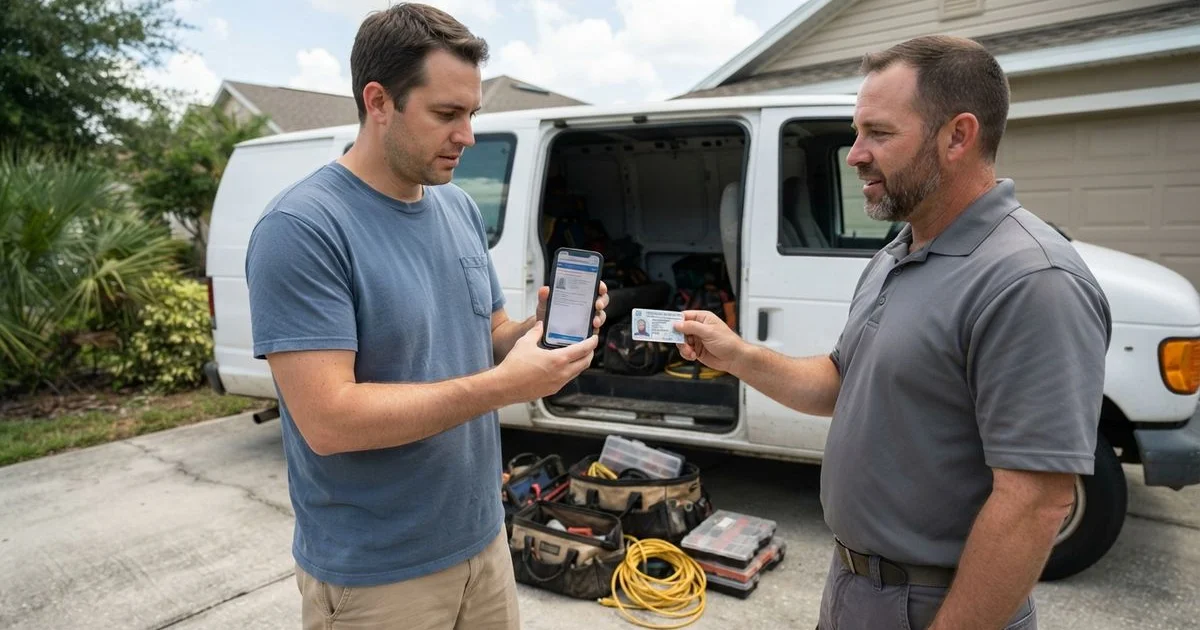
This is general information to help you evaluate a contractor, not legal advice. Licensing rules and lookup tools can change, so treat the steps below as a starting point and confirm current details with the state or county directly.
Why this is worth five minutes before you hire
Florida requires electrical contractors to hold either a state certification or a local registration to legally perform most electrical work. That license is tied to training requirements, a minimum insurance and bonding threshold, and a disciplinary record you can actually check. Skipping this step doesn’t just risk bad workmanship. Unlicensed electrical work can complicate permits, void parts of a homeowner’s insurance claim, and become a real headache if it surfaces during a home sale years later.
The two license types you’ll run into
A state-certified electrical contractor has passed Florida’s state exam and can legally work anywhere in the state. A registered contractor has passed a local competency exam and is licensed only within the specific county or city that issued it. Both are legitimate, but a registered contractor working outside their home jurisdiction is not licensed to do so, even if they’re licensed somewhere else in Florida. If you’re hiring in Sanford, confirm the electrician is licensed to work in Seminole County specifically, not just “licensed in Florida” as a general claim.
Separately, individual electricians hold trade-level credentials like journeyman or master electrician, which reflect training and experience but aren’t the same thing as the business holding a contractor license. A company can employ licensed journeymen while the contracting license itself sits with the owner or the business entity.
How to actually check
- Ask for the license number directly, either the state certification number or the local registration number.
- Look it up on Florida DBPR’s public license search, or your county’s contractor licensing division if it’s a local registration.
- Confirm the license status is active, not expired, suspended, or pending renewal.
- Check for disciplinary history. A complaint or two over a long career isn’t automatically disqualifying, but a pattern is worth asking about directly.
- Confirm the license type matches the work. A specialty license for low-voltage or alarm work doesn’t cover a panel upgrade.
| Check | Where to find it |
|---|---|
| State certification status | Florida DBPR license search |
| Local registration status | Seminole County or City of Sanford contractor licensing office |
| General liability and workers’ comp insurance | Ask the contractor for a certificate of insurance |
| Disciplinary or complaint history | Same DBPR record as the license lookup |
What good and bad answers sound like
A licensed contractor will give you the number without hesitation and usually knows it off the top of their head. Hesitation, a vague “we’re fully licensed and insured” without a number, or pressure to skip the check because “it’ll slow the job down,” are all worth treating as a pause point rather than a reason to walk away outright. Sometimes it’s a legitimate delay, like a recent business restructuring. Ask for the paperwork anyway.
For jobs that need a permit, the contractor pulling that permit under their license is itself a form of verification, since the jurisdiction checks license status as part of processing it. That’s one more reason a contractor who resists pulling required permits should raise a flag alongside any licensing question.
Insurance is a separate check from licensing
Licensing and insurance are related but not the same thing, and both matter. A licensed electrician can still be under-insured for the scope of your job, and a well-insured company can still be operating without a valid license in your jurisdiction. Ask for a certificate of insurance showing general liability and workers’ compensation coverage, especially for any job involving a ladder, attic work, or a multi-day project. If a technician gets injured on your property and the company carries no workers’ comp, that liability can fall back on the homeowner depending on the circumstances.
If something doesn’t check out
If a license comes back expired, suspended, or you can’t find it at all, don’t assume it’s a data entry error and move forward anyway. Ask the contractor to clarify directly, and consider getting a second quote from someone whose license you’ve already confirmed. For larger jobs like panel upgrades, rewiring, or generator installation, the stakes of hiring unlicensed work are higher, both for safety and for what it means if something goes wrong later.
See our methodology for how licensing status factors into how we score electricians, and browse Sanford electricians to compare licensed providers in the area.
Frequently asked questions
- Where do I actually check a Florida electrical license?
- Florida's Department of Business and Professional Regulation (DBPR) maintains a public license lookup. You can search by name or license number to confirm the license is active and see if there's any disciplinary history.
- What's the difference between a state and a local electrical license?
- A state-certified electrical contractor can work anywhere in Florida. A registered (locally licensed) contractor is limited to the specific county or municipality that issued the license, so confirm they're licensed to work in Seminole County specifically.
- Is an electrician who isn't licensed automatically doing bad work?
- Not necessarily, but licensing is your main outside check on training, insurance, and accountability. Unlicensed work also creates real problems later around permits, insurance claims, and resale, even if the job itself looks fine.
- Does a business card or truck logo count as proof of licensing?
- No. A license number printed on a truck or website is a claim, not proof. Look the number up yourself before hiring, especially for anything beyond a minor repair.