
Level 1 vs. Level 2 home EV chargers: which one do you need
By Thomas Quinn · Updated 2026-07-15
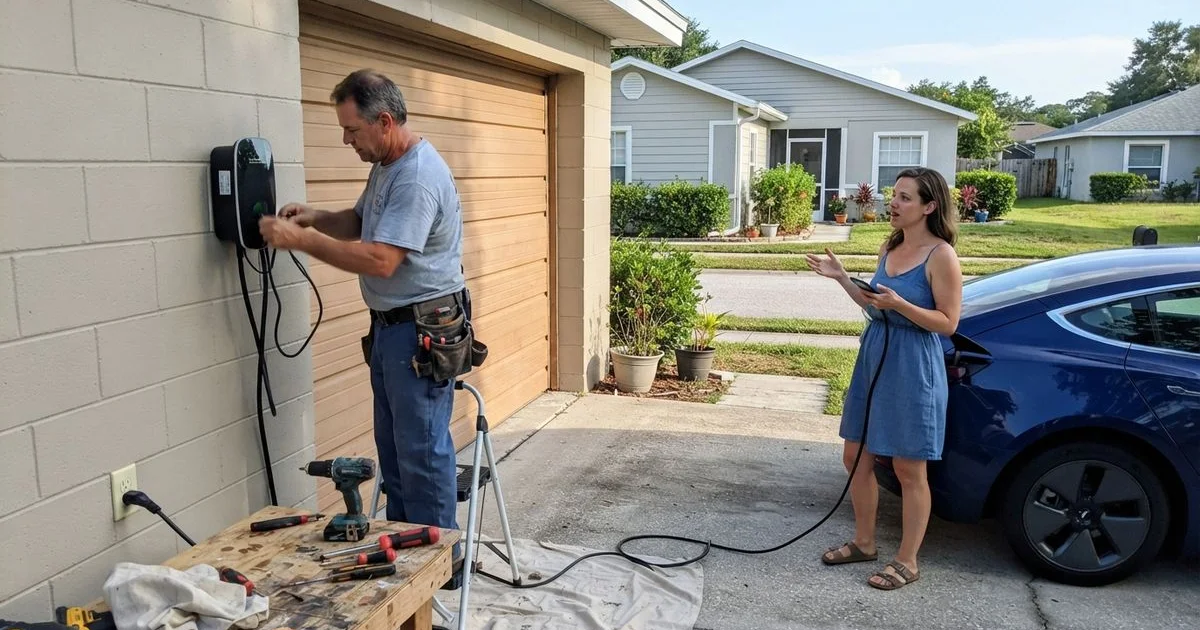
Almost every new EV owner in Sanford runs into this decision within the first few weeks of ownership: stick with the charging cable that came in the trunk, or have a residential electrician install a dedicated Level 2 charging circuit. The right answer depends less on the car and more on how far you actually drive.
What each level actually means
Level 1 charging uses a standard 120-volt household outlet, the same kind everything else in your house plugs into. Nearly every EV comes with a Level 1 cable in the box, so it’s technically a zero-cost option beyond having an outlet in your garage or driveway. The tradeoff is speed: Level 1 typically adds somewhere in the range of 3 to 5 miles of range per hour of charging, depending on the vehicle.
Level 2 charging uses a 240-volt circuit, the same voltage class as an electric dryer or range. It requires a dedicated circuit and either a hardwired charging unit or a plug-in unit rated for the higher amperage. Depending on the charger’s amperage and the vehicle, Level 2 typically delivers somewhere between 15 and 40+ miles of range per hour, several times faster than Level 1.
How to tell which one actually fits your driving
| Your situation | Likely fit |
|---|---|
| Under 30-40 miles of daily driving, car sits overnight | Level 1 may be enough |
| 50+ miles of daily driving, or limited overnight charging window | Level 2 recommended |
| Multiple EVs in the household | Level 2 strongly recommended |
| Occasional long trips, mostly local driving otherwise | Level 1 with occasional public fast charging can work |
| No time pressure, charging happens over a full weekend | Level 1 can be sufficient even for higher mileage |
A useful gut check: if Level 1 charging can’t replace what you drove that day within the hours your car is actually parked at home, you’ll be perpetually behind on range, which is the scenario Level 2 is built to solve.
What the Level 2 install actually involves
Adding Level 2 charging means a licensed electrician evaluates whether your panel has room for a new dedicated circuit at the charger’s amperage, runs wiring from the panel to the charging location, and installs either a 240V outlet or hardwires a charging unit. If the panel is already near capacity, the job can expand to include a panel upgrade or a load management device that shares capacity between the charger and other high-draw circuits like AC. This is permit-required work in most jurisdictions, since it adds a new circuit to the home’s electrical load.
Cost and timeline expectations
Level 2 installs vary mainly with how far the charging location is from the panel and whether the panel has spare capacity. A short run to a garage right next to the panel is a relatively quick job; a detached garage or a panel with no open breaker slots adds both cost and time. Get a quote that separates the charger hardware cost from the electrical labor, since some homeowners already own a charging unit and just need the circuit installed.
Questions worth asking before you commit
Ask whether your specific panel has spare capacity or whether the quote already assumes an upgrade. Ask whether the charger location requires trenching, wall fishing, or exterior conduit, since a detached garage adds real cost most online calculators don’t account for well. And ask what amperage the new circuit is rated for, since a 40-amp circuit and a 60-amp circuit both count as “Level 2” but charge at meaningfully different speeds depending on what your vehicle can actually accept.
The middle-ground option
If Level 2 feels like more than you need right now but Level 1 feels too slow, a 120V outlet upgraded to a dedicated circuit (still Level 1 speed, but without competing with other household loads on a shared circuit) is sometimes worth discussing with an electrician, though it doesn’t close the speed gap Level 2 provides. For most daily drivers who’ve outgrown Level 1’s pace, going straight to Level 2 tends to be the more durable choice rather than a stopgap.
Compare electricians who install EV chargers in Sanford on the homepage, and see our methodology for how we evaluate EV installation experience.
Frequently asked questions
- What's the actual difference between Level 1 and Level 2 charging?
- Level 1 uses a standard 120V household outlet and charges slowly, typically adding a few miles of range per hour. Level 2 uses a 240V circuit, similar to an electric dryer outlet, and charges several times faster.
- Can I just use the charging cable that came with my car?
- Most EVs include a Level 1 cable you can plug into any standard outlet. It works, but it's slow enough that it may not fully replenish a long daily commute overnight.
- Does Level 2 charging require an electrician?
- Yes, in almost every case. It needs a dedicated 240V circuit sized for the charger's amperage, which means panel evaluation, wiring, and usually a permit, not a simple plug-in.
- Will Level 2 charging damage my car's battery faster than Level 1?
- No, for a home Level 2 charger operating within the manufacturer's recommended settings. That concern applies more to DC fast charging used frequently, not standard Level 2 home charging.
Related on this site
- Browse residential electrician providers
- Aluminum wiring and knob-and-tube wiring: how to tell if your home is at risk
- Buying or selling a home in Sanford: electrical issues that come up at inspection
- Electrical safety for aging in place: a checklist for adult children
- Recessed lighting installation: how many fixtures you need and what to expect
- All guides →